Monday, July 31, 2006

Into the digital age


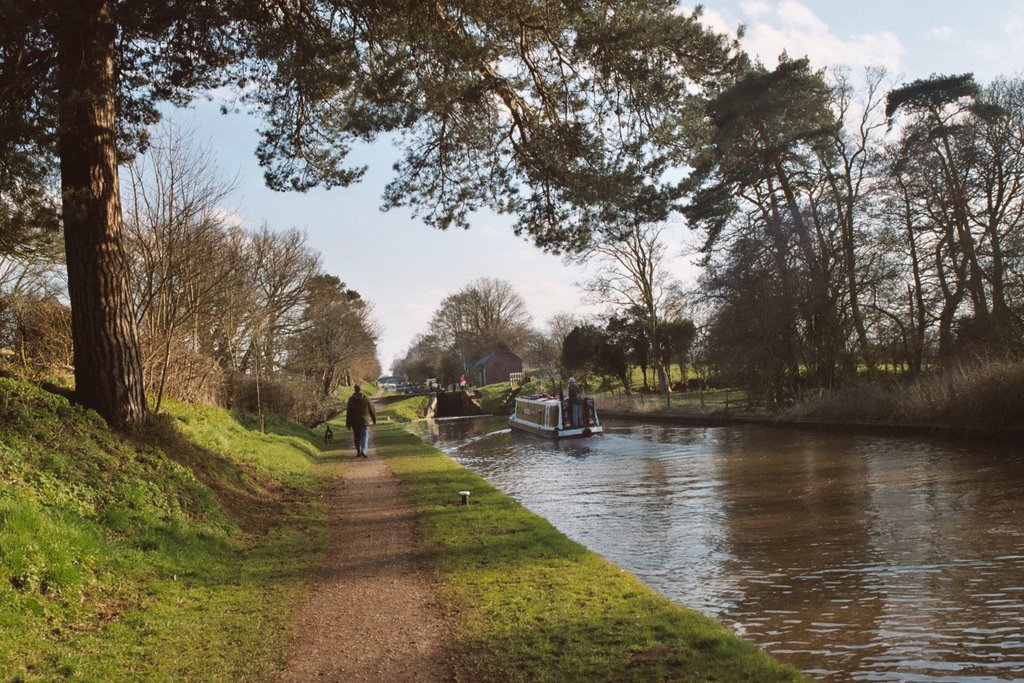
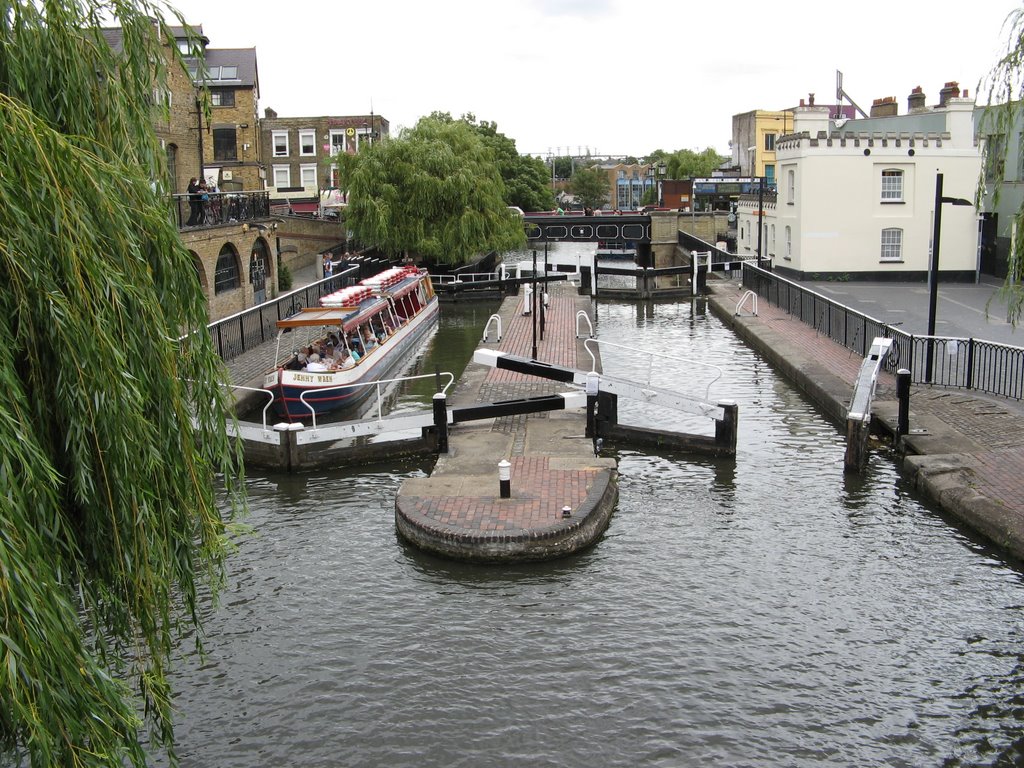
Hampstead Lane locks, Regents Canal, about 2.30 pm today ...

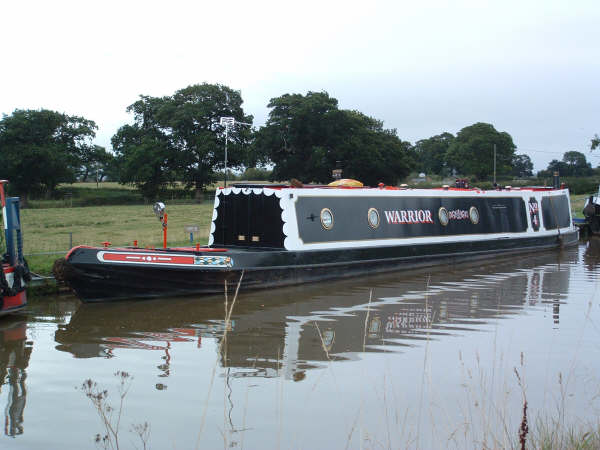
I posted a couple of weeks ago about my trusty Practika SLR camera which I bought in the early 80s when I was about seventeen, and have been using happily ever since ...well, how quickly things change! For my birthday last week (thanks Jim!) I received a Canon Powershot A700 (needless to say) digital camera. Jim's latest engine pictures, and yesterday's stove one, were taken with it. It certainly is a boon to the blogger to be able to point and shoot, upload and post, all within minutes.

But I suspect that the shift from film to digital will also have wider ramifications; it is already affecting the way I think about both taking and keeping photos. Digital images are at every stage more ephemeral, easy to take and easy to delete, and somehow that makes them seem less sacrosanct. Having been a fairly keen photographer, on and off, since my teens, I have many large boxes of prints. I've always felt it would be wrong, somehow, to destroy any of them. But at the weekend, leafing through some prints of Andante in Huddersfield, I found myself throwing half a dozen in the bin, because they were out of focus, or shaky, or simply near duplicates of better pictures. I still have the negatives though ...

More importantly, what about the digital images we do want to keep? Apart from the danger of (someone else) accidentally deleting them, will we have the right software to look at them in ten years' time? Will the hardware be compatible? Will the CDs deteriorate? Do we have to back up our most precious pictures with prints - an expensive process for decent ones. Or do we develop a new attitude to photographs, no longer seeing them as a moment frozen in time and captured forever, but as passing elusive glimpses that will themselves disappear?

Oh yes, and what was I doing at Camden Lock this afternoon? I went up to London for a meeting related to the new job I'm starting in September, and took a half-hour stroll for a little waterways refreshment. Had to fight my way through a lot of tat, but I did get to see the canal in the end.

Sunday, July 30, 2006

No fire without smoke?


This is the stove we were hoping to install in Warrior. The Morso Squirrel which was already installed, despite having nice new glass in the door, was in a parlous state. Given that it was a maximum of ten years old and that they aren't cheap, this was rather disappointing, not to say shocking. But it appears that it had been abused somewhat, being used very hot with no or inadequate firebricks in, and with water running down the stovepipe for some time, it's little wonder that the iron at the back was very badly burnt away with actual holes at the top. So that's off to the tip.

The 'new' stove is an old French one that I fell in love with many years ago in an antiques shop in Lewes, East Sussex. Round here it's quite common for antique dealers to go to France for attractively rustic artefacts and lovely enamel things like this. For years it sat in our kitchen, with us constantly meaning to get around to plumbing it in, but then last winter we got a cast iron range and fitted that instead, leaving the French stove homeless. One of the main handicaps with is is that it's a non standard size for British pipes and fittings. The other was that we didn't know whether it actually works.

So this morning we hauled it outside and lit some paper and wood in it to see where the smoke went and whether it had any serious leaks. Depressingly, it looks like it might have. I know it's not really a fair test, because it's not going to draw properly outside without a chimney (although we actually managed to rig up quite a good temporary chimney with a bit of liner left over from the kitchen range and part of a traffic cone). Even allowing for the fact that it needs new sealing stringy stuff (whatever that's called) in the top and the door, and new mica, probably, in the door (and where do you get that?), there were still mysterious wisps coming out around the top. It's hard to see where they were coming from because of the stove's double-skinned nature; it could be swirling around anywhere between the firebox and the enamel cover. I cling to the hope that it's coming out of the door then being sucked back behind th enamel to emerge from the top. We don't want to spend any money on getting a new pipe and fittings made if it's not going to get past Ian with his BSS hat on. But I really don't want to give up on it. It's the sort of dilemma that seems to happen a lot in this game.

Friday, July 28, 2006

Woo! New engine photos!


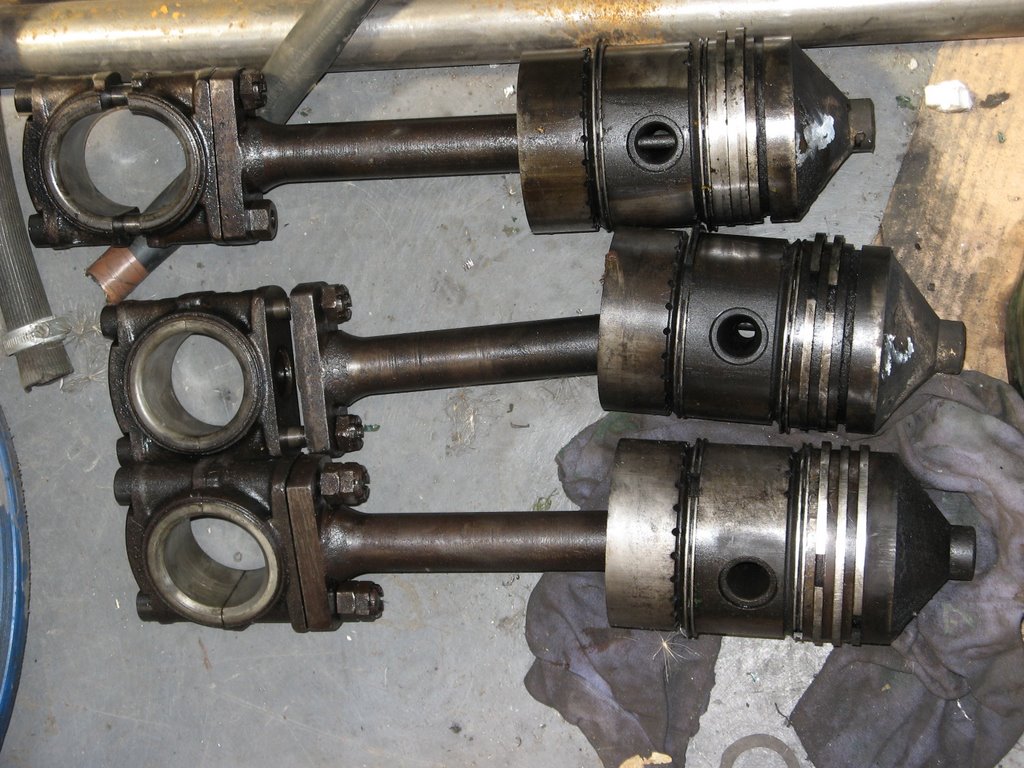
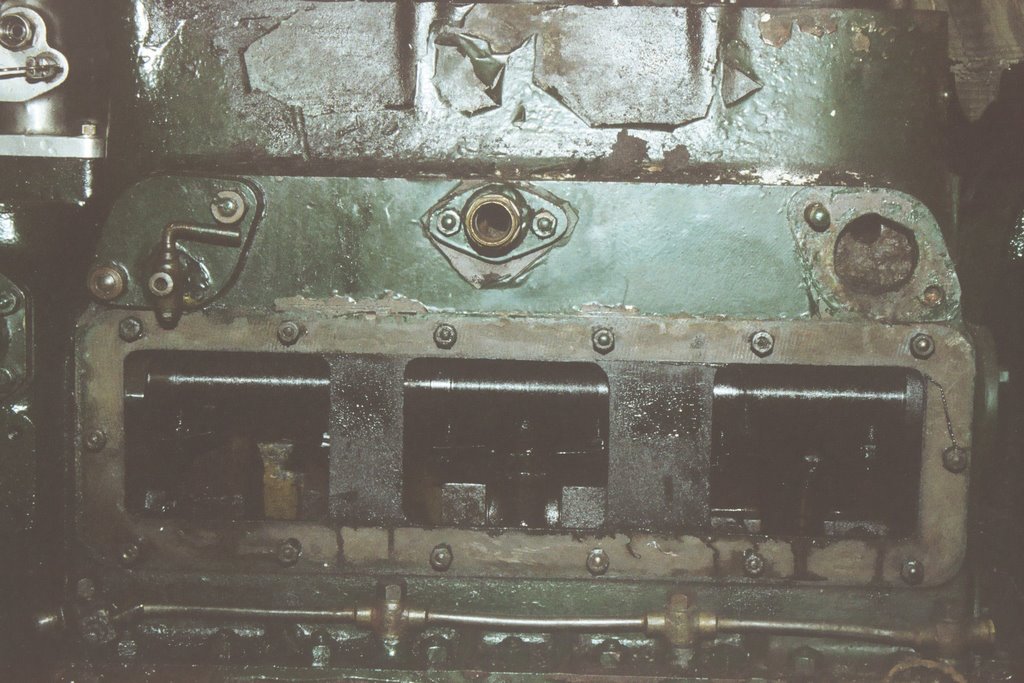
Jim has returned from his travels with a new set of engine pictures - see them here in the 'Warrior's Engine' album. All in all the news seems good: the crankshaft is basically sound and the taper will be laser welded and machined to the correct dimensions by the Custom Crank and Engineering Company of Wolverhampton. This will cost (gulp) £900. This is much cheaper than a new crankshaft (sigh of relief). The block seems to be in good shape too. The original cast iron pistons (above) are going to be replaced with new Russell Newbery alloy ones. This is a bit sad, but the old ones are, unsurprisingly, very worn, and we do get to keep the old ones to use as paperweights (or ballast?). Although some people have suggested that it would be OK to replace them with other cast iron ones - assuming we could find some - the balance of opinion is that we can run at higher revs (and that we might want to) with the alloy ones. And some Nationals were built with alloy pistons, so it's not too unoriginal.

Enjoy!

Wednesday, July 26, 2006

Travel plans

Jim's been doing some travelling this week. He's currently on Warrior - back in the water for the time being - having taken a rather convoluted journey up there, calling in at Guildford, to collect the crankshaft; Daventry, to pick up the gearbox cone; Kidderminster, to collect a teapot; and Wolverhampton, to drop off the crankshaft and gearbox cone at Custom Crankshafts who will be machining it.

Most importantly, we've finalised (famous last words!) our summer travel plans for Andante. The original plan was to do a Pennine ring taking in the Huddersfield Narrow and the Rochdale and end up back at Andante's home mooring at Aspley Wharf. I was determined not to leave here without going through the Standedge Tunnel - it'll be a long time before we get Warrior up here - if ever; Warrior might be a bit too deep drafted. The new plan includes that - then we head south, bringing Andante down to join Warrior at Stretton, where we will tidy her up and paint her, and then, I'm sad to say, sell her. The reasoning is that it will be easier to get the work done with boatyard facilities (such as they are!) and easier to sell Andante in the Midlands, especially with someone on hand to show people over, so we don't have to keep travelling up and down. It should also make for a really interesting journey, with a purpose at the end of it. And it means that when I leave Huddersfield for the last time (Jim will be coming back to collect the car) it will be by boat. Which is nice.

Tuesday, July 25, 2006

Taking sides?

Last week, Granny Buttons drew attention to the idea that there is a sharp dividing line between people who approach the waterways with an open mind and those who are obsessed with 'heritage'. This led me to wonder which side of the divide I fall on, and whether this is the only, or even the most significant, distinction to be made between different waterways users.

Part of me definitely has a strong rivet-counting tendency, best illustrated perhaps by my niggling obsession with getting the right colour paint for Warrior's engine (we have now committed on this by the way, having ordered the engine enamel from Phil Speight and asking him to match it to the best of his knowledge). It's not that there's any innate virtue in reproducing the original colour, but rather a case of, if you can, then why wouldn't you? The research, and the things you learn and the people you meet through this sort of obsessiveness, is a major part of the fun. The detective work is a challenge, and often leads to a great sense of achievement (and possibly even smugness - an emotion not to be underrated).

Do I feel we have a duty to posterity to preserve things exactly as they were? Not really - as long as there are records, and, importantly, examples, somewhere. History is important, but change is part of history and that includes changes that are taking place now. So why am I pleased to see buildings listed and working boats restored? Ninety nine percent of the time it's simply because they are just more beautiful, lovelier and better built than any modern replacement would be. I don't want to live in the past, but I do despair of the contemporary lemming rush for ever changing, gimcrack, disposable rubbish, whose only virtue is that it's 'new', the pursuit of which drives us into debt and heart attacks and ultimately the environmental grave - and which always still leaves us hungry.

Here's a thought. The age of canal transport lasted, say, 200 years. We think of this as an interesting and significant blip in history, whose end was inevitable. Mass road transport, which we take to be the norm, has been in place for about seventy years, if that.* Will it last another 130? Of course not. I'm not a great lover of sci-fi, but I like to toy with a futuristic plot in which roads are broken up and overgrown, but a few hardy souls set out to restore them so that they can chug around in their salvaged and restored lorries ...

Finally, a lot of waterways users (and I have gleaned this largely from the letters pages of the waterways press and Narrowboatworld rather than direct experience) seem to be neither interested in heritage nor open minded: the ones who complain about 'tatty boats' running their engines, about not being able to take their dog through the Standedge Tunnel, about online moorings being an eyesore or, conversely, about boats passing their online moorings too fast and so on. I don't mind seeing online moorings; I don't mind feeling the boat move, I'd rather hear an engine running than listen to someone else's taste in music, and I'd rather see a tatty, loved and lived in boat any day than a fresh out of the box identikit tub spray-painted dark blue or dark green that you have to take your shoes off to go aboard. If it's inhabited by a couple of hippies with a hairy dog on a piece of string and preferably a clutch of grubby (but happy!) children, so much the better. Bonus marks for a wind generator.

So pleasure-boating and heritage-obsession can, perhaps, go hand-in-hand. It's the misery-boaters who are out on their own!

(The above paragraph was sponsored by Hyphens-R-Us Ltd of Chapel-en-le-Frith.)

*Please feel free to correct or tighten up these figures - they're very much off the top of my head but I hope the general drift still stands.

Saturday, July 22, 2006

Now we're cooking with gas!

Friday, July 14th

Our last full day up at Warrior last week, and we took advantage of a visit from Ian not only to bend his ear about the engine, but to get him to check out the cooker, following the kitchen refit, and OK it for use. After finding and fixing a slight leak we were at last cooking with gas again. Until now, while on dry land with 240v available we'd been using a microwave - something we don't even have at home. Combined with a lack of refrigeration facilities, this rather limited our menu repertoire, and we mainly lived on tinned vegetable chilli and Uncle Ben's microwave rice. I have to say that, if you ever find yourself in the position of having a microwave and no other cooking facilities, Uncle Ben's microwave rice is highly recommended. It comes in lots of different varieties and heats to perfection in two minutes. To celebrate the inauguration of the cooker, Jim had cheese on toast for tea. This meant that I got a double helping of tinned vegetable chilli and Uncle Ben's microwave rice. Then we put the microwave in the car.

I'm a great fan of gas for cooking, at home as well as on the boat. I can't see the attraction of the 'gas free' boat - especially if it relies instead on heavy electricity use. To my mind, 240v on a steel boat is a much scarier prospect than gas - at least you can smell the latter. But then, I still find electricity in any context a little mysterious and frightening. Talking of which, we also discussed Warrior's electrical requirements, as Ian will be bringing an electrician up (or possibly down) soon. These will be entirely, or almost entirely (haven't finally decided yet), 12v.

Decisions about the engine have been going on and changing all week, but we seem this morning to have come back round to what we decided on Friday - in short, that we will do most of the reassembly of the engine ourselves, at home, rather than have pay RN rates to have it done by them, and in the meantime will get Warrior mobile again with an engine from Ian, a 1970s Lister HRW3, with a Blackstone gearbox, which we can sell on once we've finished with it. This should take the time pressure off. There will no doubt be many more hitches and changes of plan along the way, but that is the latest state of play. The latest news is that not only is our engine unusual, but that our Bruntons 1:1 gearbox is itself a very rare example. Lets just hope that we can get them both up and running!

Thursday, July 20, 2006

True Grit


Thursday July 13th

We did very little work on Warrior on Thursday, as another boat was being gritblasted. We were warned to batten down the hatches against the ensuing dust, but it wasn't too bad. We put our clear plastic sheets in the front doors and the kitchen side hatch, but the back end of the boat wasn't too affected. In fact, in the kitchen it wasn't the dust that was the problem so much as the exhaust from his enormous compressor which was lined up right alongside. Running almost continuously for what seemed like all day, this had the inestimable benefit of drowning out the sound of Radio 1 (yes, I really have got a downer on them; I honestly would rather listen to a compressor all day. More musical, too).

Well, it was very impressive to watch - and looked like an absolutely horrible job, especially on a day as hot as this was. We had (briefly) considered having Warrior's topsides (too naval?) blasted as we had the hull, but watching this decided us against it - on top of the cost (every penny well earned, mind you) there is also the hassle of masking eveything properly, and clearing up afterwards - and Warrior's paint, though horrible, is sound. So it's back to plan A, much sanding. Enter Number One Son, Lockboy's older brother, who owes us a favour or two ... He's not mad about boats, but he does like power tools, so we have high hopes of his assistance.

Other things I did while confined to quarters included putting the bed curtains up - that's a curtain on a rail either side of the steps and a flat panel in the middle, attached to the back of the steps, and I'm quite pleased with them even if I do say so myself. I also varnished the insides of the kitchen cupboards. Oh yes, and I sat out on the back and read the paper quite a lot.

Two other boats arrived and were craned out in the evening - a couple with a boat each. One of the boats, at eighteen months old, was an object lesson in the importance of removing millscale - the blacking was just falling off the hull.

I'm all alone in the office today, the kid that couldn't go on the school trip - everyone else is off on a departmental 'awayday'. The fact that I'm only here for another three weeks seemed like the perfect excuse to give it a miss. In case you're worried that I'm missing out on an all-expenses-paid treat to some exotic location, they've gone to Oldham.

Wednesday, July 19, 2006

Panelling the engine room


Wednesday July 12th

What I actually did on Wednesday was more blacking. What I am going to write about, however, is the panelling out of the engine room, which has been going on since our last visit, and is still underway.

For some reason, the engine room was never lined. This meant that it was cold and prone to condensation in the winter and an absolute oven in the summer. We are lining the cabin sides (vertically) with reclaimed old beaded edge pine t&g; the ceiling, in the same material, will be a little trickier, as the roof has a removable section for getting the engine in and out. Jim is currently working on it and it will probably end up with the middle section being a removeable panel, larger than the hatch, which screws on to the surrounding woodwork. We are using polystyrene for insulation behind the panelling. The porthole will now need a liner, but we won't be getting a brass one to match the rest of the boat; rather, we will have one made from steel and paint it.

The painting will be in pale grey for the woodwork (by and large everything above the gunwale) and raddle red on the metal, including the hull sides and engine bay. The Craftmaster paint is justifying its cost by being a pleasure to put on and covering very well.

Not one of my more scintillating posts, granted, but it's late afternoon in sweltering Huddersfield and I just want to get out of my airless office and go and swelter on Andante instead. Remember, when it's too hot to work, it's not the heat that's the problem!

Tuesday, July 18, 2006

Black stuff, and bed


Tuesday July 11th
It has fallen to me to do the blacking - mainly because I lack the myriad other skills which Jim is deploying elsewhere on Warrior. Not that blacking isn't a skilled job! (Well, no, it isn't really.) In our absence, Warrior's hull was shotblasted and two coats of blacking put on; my aim this week was to add a further three, making a total of five coats. We are using Rylard Coflex vinyl tar (comastic) and are taking it right up to the gunwale for ease of future patching up. I'm putting it on with cheap (£1.29) bristle brushes and chucking them away at the end of each coat - actually, despite being cheap they shed far less hair than most brushes I've used. I've always preferred brushes to rollers; it may be slower but it's less messy and it goes on thicker and better. This stuff went on very nicely (and the finish is authentically rough with plenty of runs and brushmarks!).

I did the third coat on the Monday, half of the fourth on the Tuesday and the other half on Wednesday, and the fifth on Friday - Thursday was a day off because a boat was being gritblasted nearby. The only bit not done is the fore end - owing to a large and apparently growing pile of gravel having been delivered around it, which provides a lovely effect of Warrior ploughing through the waves but impedes painting access. Rather than move the gravel, Keith is going to move Warrior at some point, and then we (or they) will get the last bit finished off.

The tin the stuff comes in is of course emblazened with myriad warnings to the effect of how nasty it is, and I was careful not to inhale too much of it - but I was still surprised to find that - at least in combination with the sun - it will burn skin where it drips on it. I first noticed this with a mysterious sore elbow on Monday evening which then developed burn marks; I suffered no ill effects on the Tuesday or Wednesday, but on Friday nearly every drip was leaving a mark and I finally sussed out the cause. Whether the difference was in the different tins, the temperature or the sunlight I don't know. But it's obviously good stuff!

Other tasks today included Jim building the base for the bed under the foredeck. This is as close to the floor as possible, to give us maximum headroom, but raised up enough to provide some airflow to the mattress and clear a water pipe. Originally, there was a very ingenious and well built roll out bed, but it had several disadvantages: it was narrow (3'9"); the head sloped downwards, and we had to move the furniture to make space to roll it out. Having a fixed bed under there means the bed can be wider - about 4' at the head end widening to the full width of the boat, and the head end slopes (slightly) upwards rather than downwards, making it much more comfortable. We thought of levelling it out but that would have lost us more headroom. As it is we have about two foot, which is cosy but adequate for getting in and out. The whole space under the foredeck is panelled in pine and beautifully finished - even though it was never intended to be seen. There is a large hatch over the centre of the bed that we can prop open for ventilation - before the wasp season starts I have to make an insect screen for it! We had a mattress made in 4.5 inch thick foam, covered in striped ticking, by the Foam and Fabric Shop in Seaford, East Sussex - I think it cost £270, and it's very comfortable and shaped to fit in both dimensions.

Finally, on Tuesday, we went out for dinner to the Hartley Arms in Wheaton Aston, which was pretty good; certainly much better than our other attempt at eating out in the area, at the Vaughan Arms, Lapley - definitely not recommended! After a nice meal and some very good beer we went for a walk along the towpath where we saw a lovely new boat and engaged the owner in conversation - he turned out be to a repairer of boat engines, specialising in old ones, and we may hear more of him here ...

Monday, July 17, 2006

An early start ...


And AFTER! More photos here.

Monday July 10th
We were awoken on Monday morning (as indeed on every other morning) by the arrival of a welder, at 5.45! As he didn't realise we were there, he put Radio 1 on immediately (the rest of the week he waited until he knew we were up - we always were, but it was a challenge to see how long we could keep quiet enough to stop it going on). In best holiday fashion, I have come home with a couple of mindless songs stuck forever in my head.

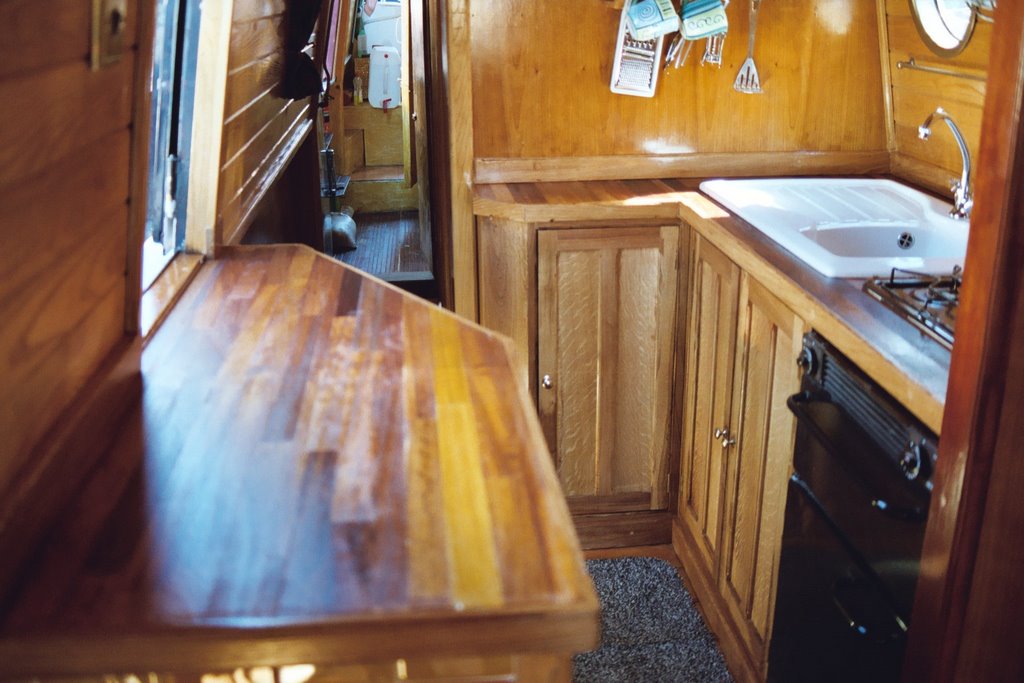
The first thing we did this morning was to look at our new kitchen. It is magnificent! And it was a total surprise - when we rang Keith to say we were coming he didn't say a word about it, and we were fully expecting to find the empty space we'd left. Looking from the front of the boat, to the left is the fridge, with a full depth worktop over it, which then tapers over about 600mm to about eight inches deep. Under here is a cupboard with double doors on the angle, and the side hatch is accessible above it. On the right is the cooker with inset hob (we reused the old one), then a white china sink with integral drainer which we bought from the local tip years ago (£3, I think) and have finally found a good home for. This has cupboards below as well, and facing you at right angles to this is a worktop about a foot deep with another cupboard below. It's a very efficient and attractive layout. All will become clearer when the photos arrive.

The worktops are iroko, a combination of worktop offcuts and timber offcuts which we found, and the cupboard doors are quarter sawn English oak, supplied by Derek, the brilliant cabinet maker who built and fitted the kitchen. The trim is ash, which we specified to tie it in with the rest of the boat. The ash trim and the insides of the cupboards have been varnished; the oak and the worktops oiled.

In the afternoon we went to see Phil Speight of Craftmaster paints (and Canals and Rivers) fame to talk about paint and painting. We came away with some light grey paint for the engine room woodwork, and having ordered raddle red engine enamel for the engine bay. We also asked him about National engine green, and he suggested that Mason's 'dove green' is about the nearest. This does look very similar to a stationary engine we saw online which was claimed to have original paint, although it was darker than Tony Redshaw was suggesting, with a sort of silvery tinge. On the way back we stopped at Wickes in Wolverhampton (God, we see some glamorous places) to buy wood for building our bed ...

Sunday, July 16, 2006

What I did on my holidays

Warrior's kitchen BEFORE! (This picture does not fully convey the horror ...)

A week under the baking sun, yards from the water's edge, hot black sand between my toes ... no, of course I wasn't in Tenerife! I was in a boatyard on the Shroppie, a much more desirable holiday destination. I still managed to acquire some impressive insect bites, plus some small but interesting chemical burns, and all without even needing my passport (which I have just renewed, after a lapse of over ten years, in order to avoid being put on the national identity database for as long as humanly possible - see the NO2ID link for details of that - it's the one link that works).

It's a funny thing, living and working on Warrior in the yard - it's a bit like setting up camp in somebody's factory, or building site. It makes me feel rather intrusive, and as if I might be getting in the way - but it's also very hard to resist watching and listening to the people working there, because it's so fascinating and instructive. Blokes, I've noticed, seem to suffer no such qualms - within minutes of arriving they're marching round like they own the place and chatting away as if they've known each other for years.

I'm very envious of that insouciant sense of entitlement; a few women (rich and particularly upper class ones) have it, but nearly all men seem to. I think this is related to the question that was raised in the press the other week about why so (relatively) few blogs, particularly political ones, are by women - one answer was that men just assume that the world is interested in their opinions, while women set the bar a lot higher in judging what they have to offer before they say anything.

Back to Warrior - we arrived last Sunday evening, just as it was getting dark, and my plan for this week is to put a daily diary up here of what we did last week - I've been making notes in the log. Photos will follow with the usual time lapse - but as the first thing we noticed on arriving was Warrior's new kitchen, just to be going on with, above is a picture of the old one. This photo does not actually do justice to its awfulness, which, as it was taken by the previous owner, is not really surprising - the trim was plastic and falling off, the tiles were very crudely stuck on top of curved-edge worktop and also falling off, and there was very little worktop space. Without altering the overall size of the kitchen, and utilising the existing fridge and cooker, we now have a layout that gives us significantly more workspace and cupboard space - more details tomorrow!

Friday, July 07, 2006

Warrior's floor


While we were at Stretton a few weeks ago, one of the things we did was to lay a new floor through Warrior, as far as the engine room. Previously there was carpet, laid on top of more carpet, laid on board. The bottom layer of carpet was very firmly glued down! We were pretty sure that we wanted a wooden floor, and I was keen to have the planks going full length across the boat, which meant we needed six foot lengths, which ruled out most flooring available in the shops. Our first preference was for douglas fir, but that turned out to be prohibitively, unbelievably, expensive. In fact, new timber of all kinds, as well as all but the cheapest laminate, was more expensive than what we ended up with: 200 year old pitch pine, sawn into six-inch-wide tongued and grooved boards, from reclaimed laminated roof beams. It took Jim two days to lay the floor, using hidden nails through drilled holes, and then we practically lived outside for the rest of the week while six coats of boiled linseed oil soaked into it. We decided on linseed oil because it's cheap and natural and the least noxious option. We use it on our pine floors at home and they've been fine. I fully expect the floor to pick up some knocks and dirt, which we can live with, but we'll protect it from the worst while cruising with some rubber-backed absorbent cotton mats we bought for 50p each in B&Q in Huddersfield. (Too much information yet?) The pine floor goes through the saloon and the kitchen; in the bathroom we will have some heavy duty vinyl which I got out of a skip; hardwood decking boards in the engine room, and red oxide paint in the back cabin.

On Sunday we're back off to Stretton, where we will be mostly painting - more coats of blacking on the hull, priming and undercoating in the engine room - and putting up the curtains which I have spent today making.

Thursday, July 06, 2006

Photos at last


I got back yesterday from sweltering in Nottingham where for once I was quite glad of an air conditioned conference centre (though I would rather have been on a boat). I've just finished uploading the first tranche of photos to Warrior's Webshots site, and it seems to work quite well as far as I can tell so far.

The photos were all taken with my trusty Practika BX20, which I bought as a teenager in the early eighties. If I remember rightly, it cost £200, including the flash unit and two zoom lenses (35-70 and 70-210mm) and is still all going strong, although the flash unit's attaching bit has been repaired with superglue, and the rewinding handle broke off at Braunston. The only other breakage occurred while Baz (aka Lockboy, but not for much longer) was carrying the camera while out on a walk and tripped over his shoelaces, landing on and breaking the 35-70 lens. Fortunately Jim was able to find a second hand replacement, although I've never found out what it cost. So don't walk round with your shoelaces undone! (Especially on a boat.) It's a big, heavy, aperture priority SLR and I'm very fond of it, although I suppose I will have to enter the digital age sooner or later - perhaps when they stop making film. Most of the photos were taken on bog standard 200 ASA Kodak film and developed and printed by Messrs Bonusprint; the last few lots I've also had put on CD in order to be able to upload them. The photos on the site are a selection from eight sets of 36, which is why it's taken a while.

You might notice that before I went to Nottingham, Baz and I tried with only limited success to establish a links list for this blog. As soon as we work out how to do it successfully, the photos will be top of the list.

Engine update: Cheryl from Russell Newbery rang while I was away to say that the crankshaft has gone to Guildford for its x-ray - fingers crossed!

Thursday, June 29, 2006

Mmmm ... pie and peas

As I will shortly be leaving Huddersfield, last night I took all my favourite colleagues out for a slap up dinner. Well, OK, I stood them pie and peas at the brilliant real ale pub The Star - under fifteen quid for nine of us (Jim had two). Pie and peas in The Star will be one of my fondest abiding memories of Huddersfield. It's the only food they do, and they only do it on Wednesdays, but if you're lucky you do get a choice of cheese and onion, beef, or pork. Yes, as in a pork pie, but served hot and sitting in a sea of peas (mushy, of course. None of your poncy petits pois here). You douse the lot with mint sauce and eat it with a spoon. Naturally on first arriving in The North I was rather sceptical about the attractions of this, but bravely plunged in, thinking 'when in Rome etc'; by the third time I was looking forward to it all day. The Star is about ten minutes walk away from the canal, but totally worth it if you have the slightest respect for beer - they always have loads of different real ales, always very well kept; no TV, no music, just a rather sweet dog. I shall miss it greatly.

My second favourite Huddersfield pub is the Albert, in the town centre. Recently reopened, and newly listed after a worrying few months at the beginning of the year, they now do food (which I haven't tried) and a decent pint (which I have, often), but the main attraction for me is the stunning Victorian interior, particularly the bar, all marble, mahogany and mirrors.

Nearer Aspley Basin is the New Wharf, which proudly advertises that it's been given an award for its food ... by the Huddersfield Student newspaper. When I ate there, admittedly about a year ago now, the food was average but edible, but the beer was dire. When I went back a second time, both food and beer were worse. So I've not been back a third time. Pity, as it has a nice eccentric, eclectic interior and a nice feel about it. Right on the basin of course is the Brewers Fayre (why, just typing that made me feel a bit queasy) 'pub' The Aspley. Just don't go there. They don't need your custom. There are enough people with no sense and no taste and no idea to keep them full every night of the week.

Oh dear, this seems to have turned into a pub review - well, I did try to relate it to the canal.

Wednesday, June 28, 2006

Bits and bobs

I'm dead chuffed this morning to find nb Warrior on Granny Buttons' blogroll. I am steeling myself to have another go at setting one up here but I am so technologically challenged in this area it may take some time yet. Advance apologies - it will be a bit quiet here for the next week or so: I have to go to a conference in Nottingham next week and then we'll be back at Stretton with Warrior the week after that. Over the weekend I shall be trying to set up a photo website(see above for caveats). I'm thinking of using Webshots - it's less glitzy than Flickr but it looks simpler, and you get to post more photos on the free account (240 as opposed to 200). Any other suggestions?

This afternoon Andante should finally go back to her own spot on the towpath at Aspley (Huddersfield). Just before our epic trip at Easter we got a call to say she'd been broken into (in the middle of the morning! Big lump of stone through the window, followed by a couple of skinny herberts - must have been skinny to get through the window. Nothing taken (nothing to take) except an aging gas lighter, and blessedly no gratuitous damage done, just glass everywhere and a chunk out of the woodwork where the stone landed) so we made a detour to replace the window and fit security bars. At this point she'd been moved into the basin for security and someone else had nicked her towpath spot, so she's been sitting in the basin ever since, right up against the pub car park. Which is really no fun. That is, until I turned up on Monday to find her gone - moved round the corner to make room for a new boat. So this afternoon reinforcements are arriving to fight our way back onto the towpath somewhere. First off though a well deserved pumpout and watering should see her sitting a little less drunkenly. You were right Mike - those tanks are enormous. We emptied Warrior's water tank in three days and couldn't work out what had happened, we've been so spoilt.

Monday, June 26, 2006

A grand day out


Braunston: beer, beanburgers, boats - what more could a girl want?

Lots of other things that don't alliterate satisfactorily but were also present: sunshine, friendly people old and new, engines, morris dancers (OK, I can take or leave them), teenagers scarily good at handling boats; boats and more boats (although perhaps not quite the numbers they were hoping for? I confess I didn't count). Well worth the 320 mile round trip and £10 car parking charge.

But, I hear you ask, what about the National Paint Colour Mystery? It deepens (or lightens). Apparently it should be neither bright green nor dark green, but according to someone who ought to know (just what is the protocol on naming people?) 'a sort of dirty lime green with black in it' and 'really horrible'. So horrible that it seems no one has attempted to reproduce it on a rebuilt engine. The colour he picked out on our chips was more what I'd call a sort of darkish eau-de-nil - a good thirties colour for a thirties engine. So what we need to do now is to track one down (possibly our own) with some original paint still on it and try and find a match. It might be argued that it really doesn't matter - people could paint their engines any colour they liked and it needn't try to look as if it's straight out of the box. But if we're going to do it, why not try to get it right - tracking these things down is so much of the fun of it. Of course, that might not be the last word on the subject - someone else again might have other ideas about how it should be. Anyone got any ideas of other ways of finding out?

Friday, June 23, 2006

Green paint


Just a quick post today - firstly thanks to Mike for picking up on yesterday's rant and making me feel like part of the blogging community! Secondly, if anyone ploughed through the post about Warrior's engine and thought they detected the odd schoolboy (girl?) error, well all I can say is hopefully they're gone now.

We're off to Braunston tomorrow, armed with a set of paint colour chips in various shades of mid to dark green which we will be holding up to any National engine we can get near enough to. Warrior's engine is currently painted quite a dark green, and a cursory examination hasn't revealed any other shades underneath. While at Daventry we saw two engines - one RN and one National - nearly completed and both painted the same shade of what I think of as 'park bench' green - lighter and brighter than Warrior's. It seemed to me that it would be a bit of a coincidence for a separate company, having licenced the design from RN to make under its own name, to paint its engines exactly the same colour - surely National would already have their colour schemes established?

Thursday, June 22, 2006

Why do so many people want to buy new boats?

This is a subject that's been exercising me for a while, particularly given the preponderance of stories recently about the pitfalls encountered by the buyers of new boats - poor steelwork leading to sinking; builders going out of business owing customers tens of thousands of pounds; the near impossibility of getting moorings, plus smaller scale local stories about a new boat that's on its third engine, for example ...

Sometimes people buy a new boat because they have very specific requirements, and want a boat built to meet these exactly. This is a reason often given by people whose boats are reviewed in the glossy mags (and frequently make a second appearance in the brokerage ads a year or two later). There are hundreds of boats for sale in Britain at any given time - 378 on Apollo Duck alone yesterday, many of them no more than a few years old - is not a single one of them suitable? Have these people even looked? (Possibly not; I remember reading a review a few years back of a new semi-trad. The owners were very pleased with their boat, but said that had they known about the possibility of having a trad with a back cabin, they would have preferred that.)

But anyway, while it may be true that some people have very specific needs or wants, and have a boat custom built to meet them, that doesn't account for all the bottom end boats sold off the peg with little scope for customisation and even less character or aesthetic appeal. The longest queue I saw at Crick was for the New Boat Company's boat. What's with these people? Even if they can't afford a boat by one of the 'top' builders exhibiting there, aren't they even interested in looking? I'm not saying no one should ever buy a new boat - I don't want to see high quality bespoke builders and fitters running out of work; I don't want to see the supply of good quality boats dry up. But in terms of numbers, we are talking increasingly about boats being made on production lines in Poland and Morocco, and even China (max length 48' to fit in a shipping container). Surely in many cases the same money would buy a much nicer boat that's a few years old.

Lots of people, it seems, simply never as much as consider buying anything 'second hand'. These are the people that buy a new car every three years and whose complaints about said cars fill the consumer and motoring pages of the press. The sort of people who buy a Barrett home because they don't like the idea of having a second hand toilet (I have seen that cited as a reason!) I would never buy a new car, or a new house - let someone else have the inevitable teething troubles, and pay extra for the privilege. But then as far as possible I don't buy new clothes, or furniture, or anything where I can utilise some one else's cast-offs, save money, stop something going into landfill and end up with better quality stuff to boot. But to many people, that seems to be a completely alien world.

Back to the problem of moorings: of all those hundreds of boats currently for sale, most are taking up a mooring somewhere. In many cases they haven't moved or even been visited for years. That's a complete waste of a mooring. Add to those the hundreds more (at a wild guess) that aren't currently for sale but whose owners don't or hardly use them and would sell if there was a buyer. If moorings owners, including BW, allowed moorings to be transferred with a boat this could provide a significant incentive to buy an existing boat rather than add a new one.

Building new boats uses resources and fossil fuels (OK, marginal amounts in the scheme of things, but everything we do as individuals is marginal in the scheme of things, it doesn't mean it's not worthwhile). If a beautiful, well made, loved and used boat is the result, then that's arguably a good use of those resources. If it's an ugly tub that causes its owners so many problems they give up on boating altogether, then that's a wicked waste. Especially when there are so many (potentially) nice boats out there just waiting for someone to love them.

Tuesday, June 20, 2006

A trip to Daventry


We took a brief day trip yesterday to Daventry, to visit (aah!) Warrior's engine where it sits in the workshop of the Russell Newbery Diesel Engine Company. This trip was to find out their first impressions of what sort of state the engine's in, and also do do a bit of bridge-building, having got off to a rather shaky start with one of the RN mob who, let us say, hasn't exactly been to the Dale Carnegie school of customer relations - although, to digress here, as I am wont to do, I'm not entirely convinced that it's a bad thing that there are genius engineers (for such, we are told, this person is) out there who don't subscribe to the bland 'have a nice day' approach. Anyway, yesterday we talked mainly to the bearded contingent (David and Ian) who were very nice and helpful; Ian in particular is very good at explaining things, without even seeming to notice he's doing it. So we are now committed to Warrior's engine receiving their expert care and attention, having been told by everyone we've talked to about it that they might be grumpy and miserable, and they might be slow, but that nobody will do a better job.

So what was the verdict? Well, no nasty surprises, at least as yet. The block seems to be in good shape, full of rather frightening sludge, but David says that's normal. The pistons are in OK shape, but we will probably replace them anyway - they need new rings, and they're cast iron, which means they shouldn't be used above 800 revs, which apparently we would want to do, so we will replace them with alloy ones. The crankshaft is going to be thoroughly inspected and sent off to Guildford for an x-ray (aah again) but on cursory inspection looks to be OK. The camshaft is going to be remade on a special machine they have for the purpose (they have a lot of old machines).

We will have a new alternator as supplied by RN. The starter motor, while not original (the engine was originally hand start) is an old and repairable CAV one, in pretty good nick, so that stays. The water pump is a bit more of a poser - the previous owner noted that water pumps were constantly wearing out and it turns out that this is because they were attached to far too large a pulley, making them run about six times as fast as they should. There's no space at the flywheel end to add a smaller one, so we are left with two alternatives. One is an electric water pump, which we'd like to avoid for authenticity's (and reliability's?) sake. The second is that on the front of the engine there is a cover, which apparently covers a spindle that would originally have been used to drive a water (presumably raw water) and bilge pump; it may be that this can be adapted for the purpose provided it won't protrude too far into the gangway. We won't need a fuel pump (it previously had an electric one fitted) as we are having a gravity system installed - they've already made the day tank, although we haven't seen it yet.

The gearbox was quite a nice surprise, in that it turns out to be quite sound. It is (we're told!) an early Bruntons box, 1:1, all metal parts, very simple. It looks like it might require a slight modification to the propshaft to allow some backwards/forwards movement, and this may be why it wasn't engaging effectively before. The gearbox does sport a National plate with the engine number on, which is what led us and previous owners to think it was a National box. We're still pretty sure it's the same box the engine has always had, but was the plate put on by an owner, or were these Bruntons boxes badged by National?

After this successful visit to Daventry we went on to Whilton to have lunch at the garden centre at Whilton Locks, and then we made a move for home - all in all the round trip took from 0730 until 1700 - and we weren't more than an hour at RN. We'll be doing pretty much the same trip on Saturday when we're going to go to Braunston - I've volunteered to drive, as long as my beloved Bluebird is back on the road by then. The cars are another story, but when Warrior news is slack I might get round to it!

Will try to add an engine-in-bits photo later, but I haven't yet joined the world of digital photography so have to wait till I've finished the film and got the pictures back!

Thursday, June 15, 2006

What sort of a boat is Warrior?

What Warrior looks like - but ignore the paintwork - that's going! (Believe me, it looks worse close up)

Last month in Canals and Rivers magazine, Phil Speight was expostulating about the way any old (or new) boat with a bit of a curvy fore end and/or a few washer rivets gets sold as a josher - and it's true, you only have to look at the ads. His point was (I think) that this devalues the skill and effort of those few people who build/built faithful josher replicas, as well as rendering the term itself - which should be very specific - pretty much meaningless. He also had a few digs at boats that are called tugs because they have a longish foredeck and portholes.

It is into this latter category, of course, that Warrior falls. I don't have much problem describing Warrior as a 'tug-style narrowboat' (it's a fairly widely and consistently understood term), but a tug it definitely isn't. Although, with the engine it's got, I suppose there's no reason why not! Looking at real tugs, their proportions are noticeably different; generally, more foredeck, less cabin, and less length overall (Warrior is 54'). After all, generally speaking they neither carried goods nor were lived on; apart from the engine, what did they need space for? (Not a rhetorical question, I would actually like to know.) There are some leisure boats about that do suggest those proportions more accurately, but at the cost, obviously, of accomodation.

Warrior has a fairly distinctive fore end, more suggestive of an icebreaker than anything else, I think. I've asked John Shotbolt (the builder) whether the design is based on any particular boat or style of boat, and the answer was no. That makes Warrior a real one-off, as it was the only tug (-style narrowboat) he ever built. An interesting, characterful, nice looking and well built one-off. And that's before we even start talking about the engine, which is, as far as we know, unique on the British inland waterways system. That'll do me.

Having said all that about how Warrior doesn't really look much like a real tug, that is how we're going to paint it, when the time finally comes. We might even attempt a bit of tromp l'oeil to make the cabin look shorter, at the very least keeping it very plain toward the front. All part of the compromise inherent in canal boating between history and practicality.

Returning to my starting point, why even try to ape the shape, style or appearance of old boats when we all know it's fake? Not to recreate history, create a floating museum, or romanticise life on the working boats, but quite simply because those old boats are the most beautiful. And if you're going to do something, then you should do it the very best you can.